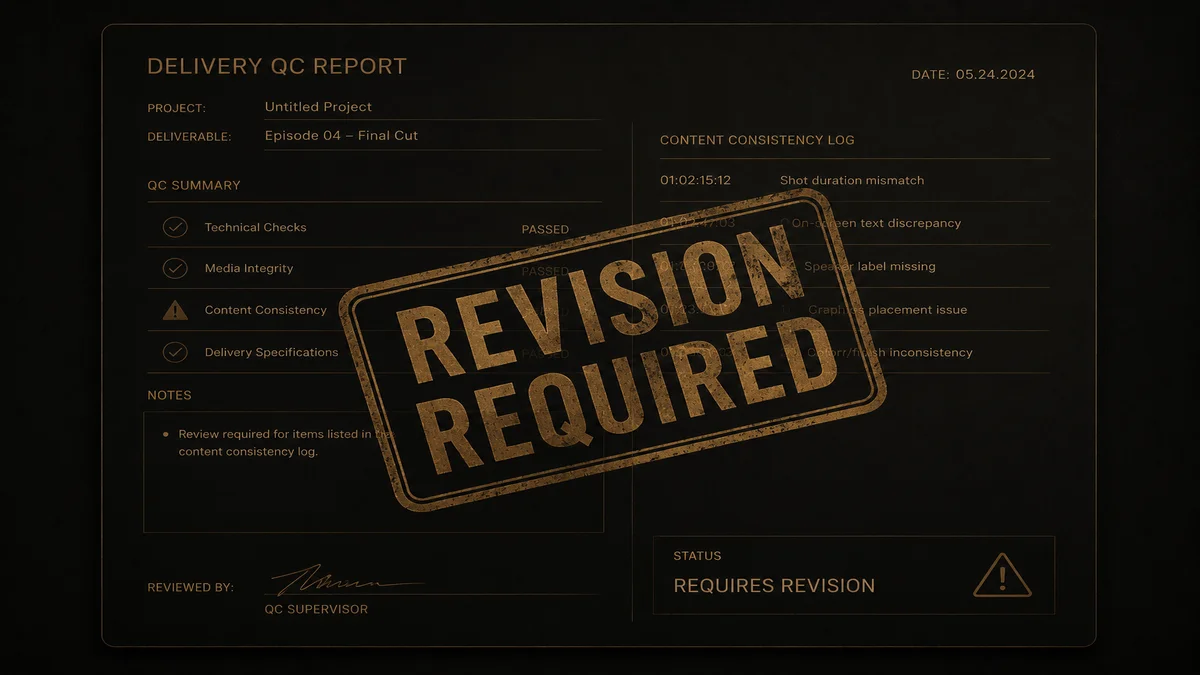
A rejected CCSL is one of the most avoidable — and most costly — delays in the delivery process. Distributors and streaming platforms run every submitted CCSL through a quality control review before accepting it, and even small errors can send a document back for revision, pushing back an entire delivery window.
Here are the most common reasons a CCSL gets rejected, and how to avoid each one.
1. Timecodes Don’t Match the Final Master
This is the single most common rejection cause. If a CCSL is built against a picture cut that changes even slightly before final delivery — a trimmed frame here, an added shot there — every timecode after that point can drift out of sync. Platforms cross-reference the CCSL against the actual delivered file, so even a few frames of misalignment can trigger a rejection.
How to avoid it: Never begin CCSL work until picture lock is fully confirmed, and confirm again before final delivery that no last-minute changes were made to the locked cut.
2. Formatting Built for the Wrong Platform
Netflix, Amazon Prime Video, Apple TV+, and other platforms each maintain their own CCSL formatting requirements. A document built correctly for one platform’s spec will often fail another platform’s QC review, even if the underlying content — dialogue, timecodes, speaker labels — is accurate. See our breakdown of Netflix’s specific CCSL requirements as one example of how detailed these differences can get.
How to avoid it: Confirm which platform’s spec applies before work begins, and never reuse a CCSL built for one platform as-is for another.
3. Missing or Inconsistent Speaker Labels
Every line of dialogue needs a clearly identified speaker, including background voices, off-screen dialogue, and voice-over narration. Missing labels — or labels that are inconsistent from scene to scene (e.g., a character referred to by first name in one section and by role in another) — are a frequent QC flag.
How to avoid it: Establish a consistent speaker-naming convention at the start of the project and apply it uniformly throughout.
4. On-Screen Text Omitted or Merged into Dialogue
Signage, text messages, title cards, and other on-screen text need to be transcribed separately from spoken dialogue, not folded into the same column. Platforms rely on this separation for localization teams working on subtitles and dubbing.
How to avoid it: Treat on-screen text as its own category throughout the document, formatted according to the specific platform’s requirements.
5. Song Lyrics Handled Incorrectly
Song lyrics need to be transcribed accurately, and clearly labeled as either diegetic (audible to characters within the scene) or non-diegetic (score, not heard by characters). Missing lyric transcription, or failing to distinguish between the two, is a common oversight — especially in music-heavy projects.
6. Outdated Template After a Platform Spec Revision
Streaming platforms periodically update their technical delivery specifications. A CCSL built using a template that was correct six months ago may no longer match the current requirements. This is one of the more frustrating rejection causes, since the document may be internally accurate but still fail QC purely on formatting grounds.
How to avoid it: Work with a CCSL specialist who actively tracks platform spec changes, rather than reusing the same template indefinitely.
What Rejection Actually Costs
Beyond the immediate delay, a rejected CCSL typically means:
- A full revision cycle, adding days (sometimes longer) to your delivery timeline
- Delayed localization work, since dubbing and subtitling teams can’t begin until the CCSL is accepted
- Risk to festival or platform launch deadlines that don’t move regardless of documentation delays
Getting It Right the First Time
Most of these rejection causes come down to the same root issue: formatting and precision requirements that are easy to overlook without dedicated experience across multiple platform specs. Gotham CCSL’s CCSL creation services are built specifically to avoid these pitfalls — accurate, correctly formatted, and aligned to the exact platform you’re delivering to, so your first submission is your only submission.
Comments are closed